
In KNX smart building systems, reliability begins with proper cabling. While some installers mistakenly assume that any twisted-pair cable will do the job, KNX requires its own certified cable—and deviating from that standard puts the system’s stability at serious risk.
The Standard KNX Cable
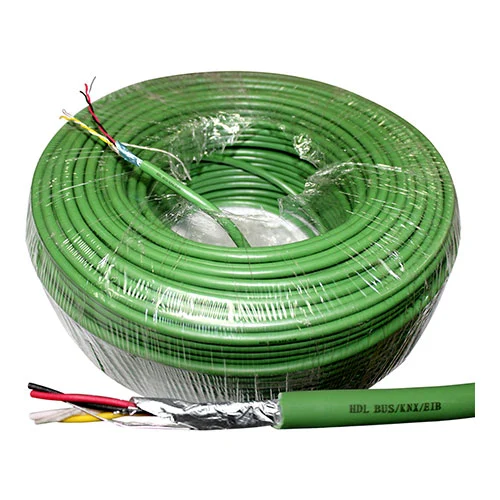
KNX-certified cable (as defined in EN 50090) is specifically engineered for bus-based smart control systems. Its technical properties include:
- Solid copper conductors, typically 0.8mm in diameter
- Twisted pairs with consistent impedance
- Low capacitance and controlled resistance
- Simultaneous transmission of 29V DC power and data signals
- Outer insulation designed to reduce electromagnetic interference (EMI)
These characteristics are essential for ensuring that KNX telegrams are transmitted accurately and without delay—even in large installations.


Can You Use a Network Cable Instead?
No. Ethernet cables like CAT5e or CAT6 are not suitable for KNX, even if they physically resemble the correct cable. Using them introduces serious risks:
- Voltage drop over longer distances
- Communication instability, especially in topologies with multiple devices
- Lack of certification = no guarantee of future reliability
- No shielding appropriate for EMI environments typical of modern buildings
What might seem like a “cost-saving shortcut” often results in costly repairs or full system rewiring later.
A Note on ELV Systems and CCTV
KNX cabling often runs in parallel with other low-voltage systems—such as CCTV, intercoms, and access control. However, just because they share the ELV label doesn’t mean they can share the same cabling strategy.
Each system has its own signal characteristics and interference thresholds. KNX bus cables must remain dedicated and isolated. Using shared or generic cables—even shielded CAT6—for multiple systems can compromise the KNX network.
If you’re planning a full smart home or integrated ELV system that includes CCTV or IP-based subsystems, we recommend visiting SmartHomeDubai.org, which focuses on broader smart home and surveillance solutions beyond the KNX ecosystem.

- How to Choose the Right Smart Home System in the UAEHow to Choose the Right Smart Home System in the UAE Smart home technology is evolving rapidly — but one thing remains the same: your system… Read more: How to Choose the Right Smart Home System in the UAE
- 🎵 Multi-Room Audio in Smart Home Automation – What It Is and Why It MattersWhat Is a Multi-Room Audio System? Imagine playing your favorite music in the kitchen while your kids listen to their playlist in the living room —… Read more: 🎵 Multi-Room Audio in Smart Home Automation – What It Is and Why It Matters
- Smart Home Automation Hack!🧠 Introduction: Can Smart Homes Be Hacked? With the growing popularity of smart homes, one of the most frequently asked questions is:“Can my smart home be… Read more: Smart Home Automation Hack!
- Is Wireless KNX a Reliable Choice for Your Smart Villa in Dubai?KNX Media can convert to other with coupler device or gateway to connect other protocol such as Dali, Ethernet and so on. 🟠 Introduction: With years… Read more: Is Wireless KNX a Reliable Choice for Your Smart Villa in Dubai?
- Integration of Intercom and CCTV in KNX ProjectsA Seamless Approach with INSPINIA In many of our recent smart villa projects across Dubai, our clients have requested a fully integrated solution that covers lighting,… Read more: Integration of Intercom and CCTV in KNX Projects
The Bottom Line
If you’re building or renovating a high-end smart property and using KNX as the backbone of your automation, make sure your installer:
- Uses only KNX-certified cable
- Avoids network cables or “multi-purpose” wiring
- Follows proper topology and grounding rules for KNX
- Understands interaction with nearby ELV systems
In KNX, the cable is not just a wire. It is part of the system.
If the cable is wrong, the system is unreliable—period.

Using non-certified cable may result in unpredictable behavior, including communication failure, delayed responses, and errors in device synchronization. It also voids compliance and may lead to costly troubleshooting or rewiring later.
No. Although CAT6 cables may appear similar, they are not designed for KNX communication and can cause voltage drops, signal errors, and long-term instability. Only use certified KNX cable for guaranteed reliability.
KNX cable is built to meet EN 50090 standards, with specific electrical characteristics such as 0.8mm solid copper conductors, controlled impedance, and integrated power/data transmission over a single bus line. These features are essential for proper KNX operation.
Yes, but with caution. While KNX cables can share the same conduits or trays with other ELV systems, it’s critical to avoid signal interference. Never share cables between KNX and CCTV. Use proper separation and grounding methods.
For information on integrated smart home systems—including CCTV, access control, and non-KNX ELV infrastructure—visit our partner site: SmartHomeDubai.org